
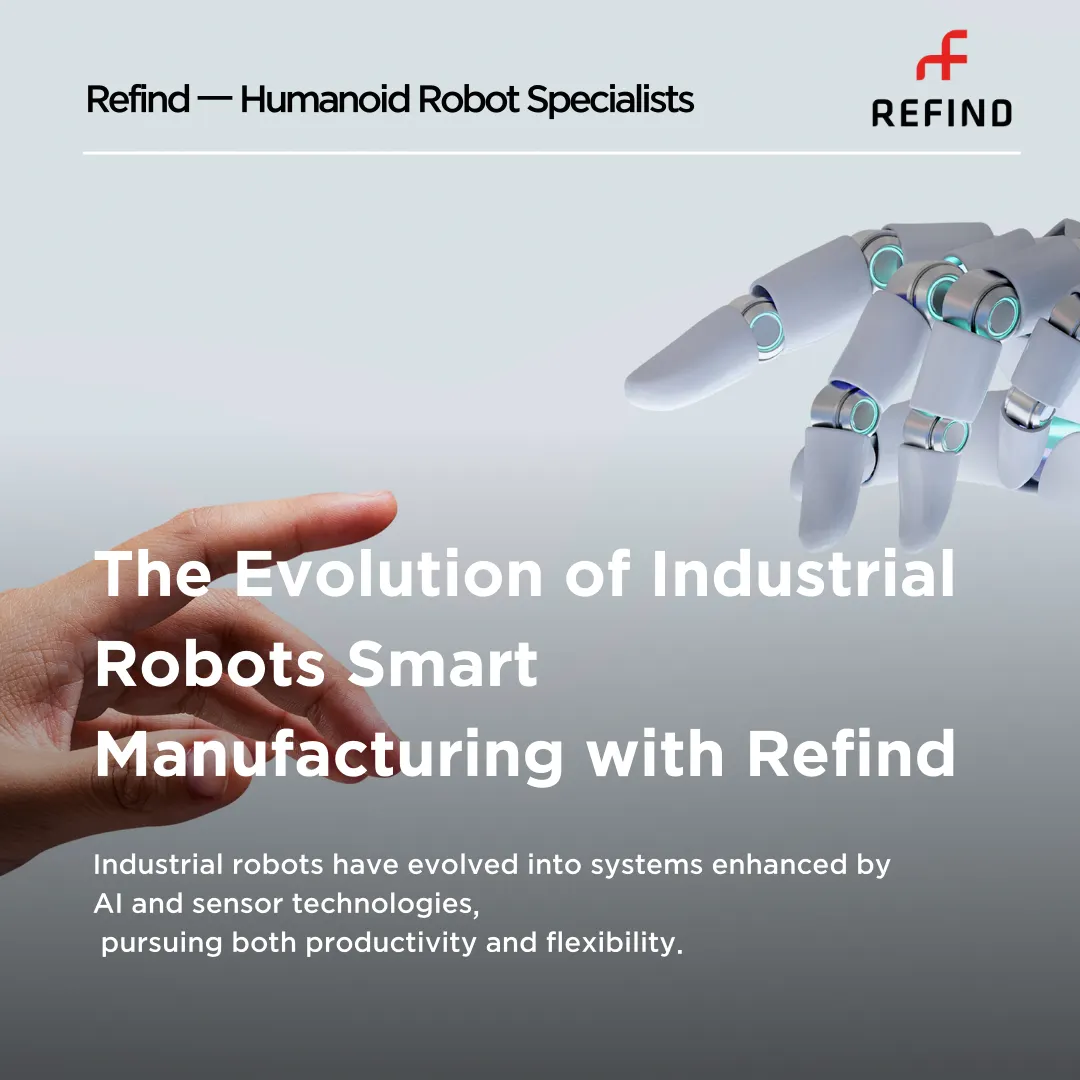
Industrial robots have become a core technology reshaping the paradigm of modern manufacturing.
They have evolved far beyond simple automation tools, emerging as intelligent systems powered by AI and advanced sensor technology—offering both productivity and flexibility.
Refind Inc. contributes to this transformation through ROHAND (humanoid robotic hand) and tailored ODM/OEM solutions for smart manufacturing environments.
The Development Journey of Industrial Robots
Industrial robots were first introduced in the 1960s in automotive assembly lines and have steadily evolved since.
Early models could perform only limited tasks based on fixed programming,
but today’s robots—equipped with multi-DOF designs and real-time control—can execute far more complex movements.
For example:
•
FANUC’s 6-axis robots deliver precise 3D motion
•
Integrated vision systems such as iRVision improve picking and inspection efficiency
•
Depth cameras like Intel RealSense provide spatial awareness, enhancing environmental adaptability
This evolution has accelerated with the adoption of AI and IoT.
Industrial robots can now analyze sensor data in real time, adapt their behavior accordingly,
and support remote monitoring via cloud integration.
ROhand
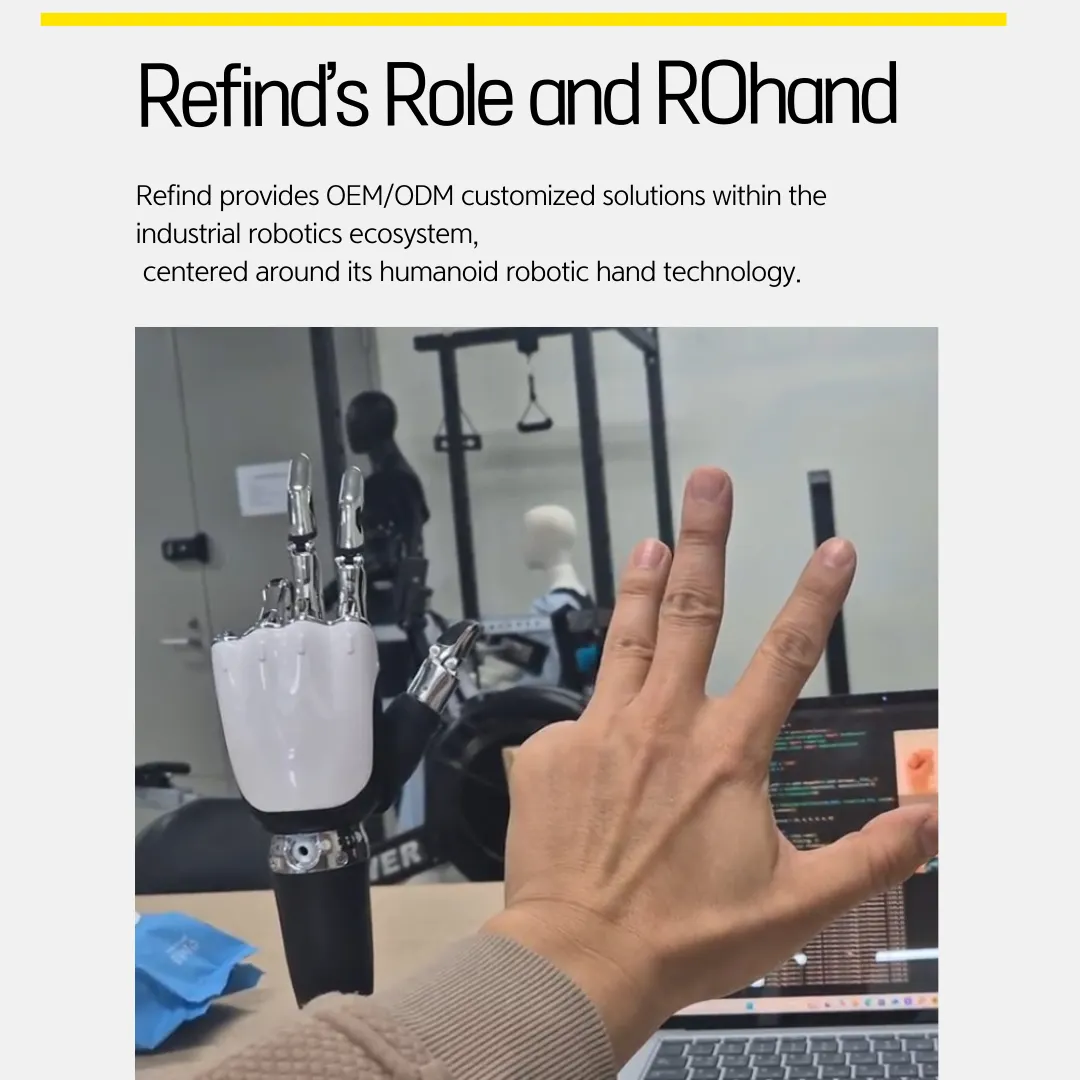
Refind’s Role and ROHAND
Within the industrial robotics ecosystem, Refind offers customized ODM/OEM solutions centered on its humanoid robotic hand, ROHAND.
Key Features
•
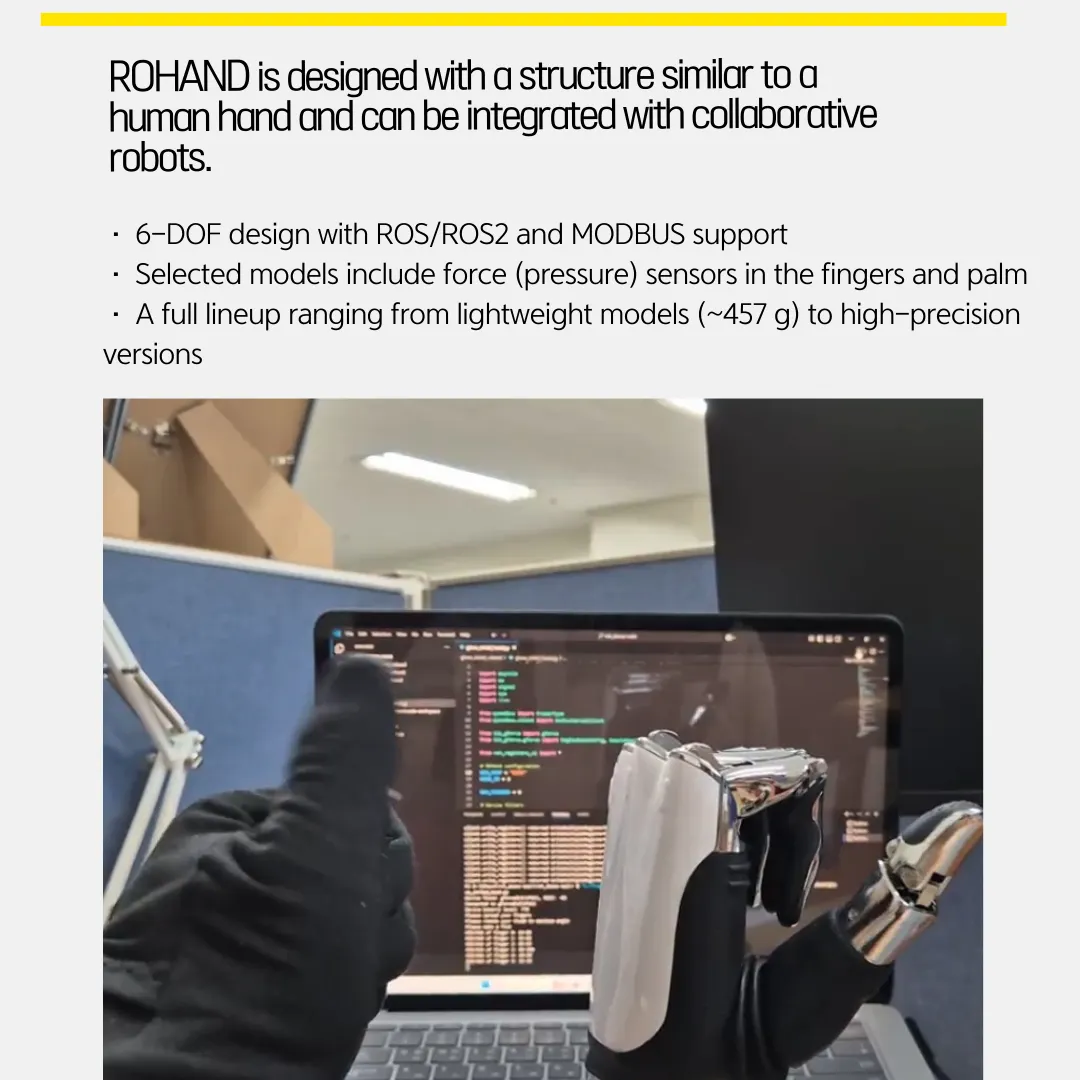
6-DOF design
•
Supports ROS / ROS2 and Modbus
•
Select models equipped with force/pressure sensors in the fingers and palm
•
Product lineup ranges from lightweight models (~457 g) to high-precision variants
These capabilities make ROHAND suitable for electronics assembly, semiconductor precision handling, inspection processes, and more.
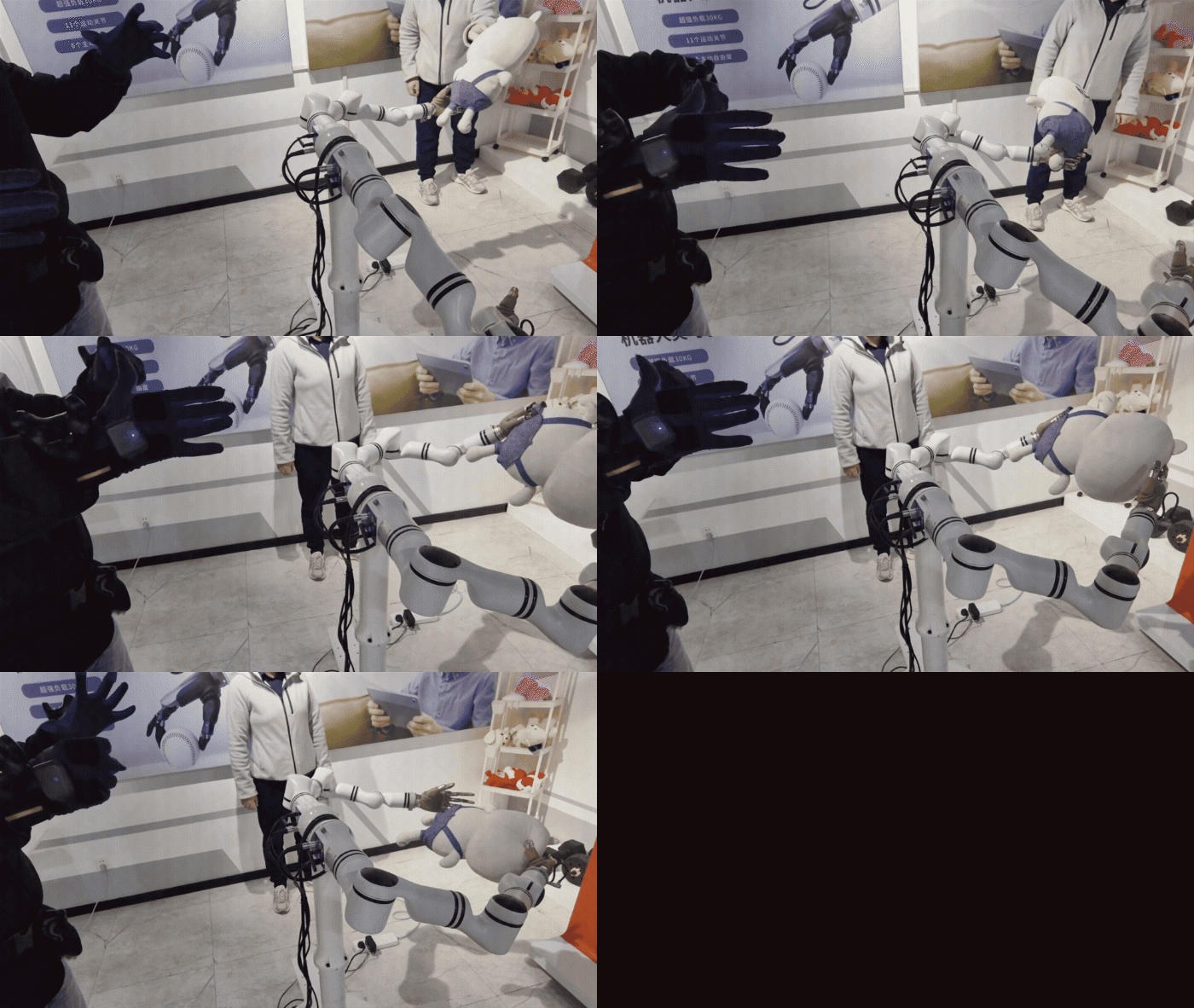
Because it mimics the structure of a human hand, ROHAND is increasingly recognized as a collaborative robot (Co-bot) end-effector option for tasks requiring human-like manipulation.
However, safe collaborative operation must meet system-level safety standards, including the robot body, controller, and operating environment.
Use Cases in Smart Manufacturing
Smart manufacturing leverages industrial robots to increase both efficiency and safety.
For instance, Tesla Gigafactory Shanghai is known for its high level of automation and short cycle times,
with battery module and pack lines that heavily rely on robotic processes.
Leading global manufacturers are rapidly adopting robotic technologies to enhance productivity.
Refind’s ROHAND is evaluated as a key technology supporting this trend, especially for processes requiring precision gripping and manipulation.
Challenges and Opportunities
Despite rapid adoption, several challenges remain in expanding smart manufacturing:
•
High initial investment — burdensome for SMEs
•
Shortage of skilled operators — need for trained robotics and maintenance specialists
•
System integration complexity — requires expertise to connect robots, sensors, and software into unified workflows
Refind is addressing these issues by expanding ODM/OEM-based customization support
and strengthening its collaborative ecosystem to broaden the practical applications of ROHAND.
Future Outlook and Refind’s Direction
The future of industrial robotics will be increasingly intelligent—powered by 5G, edge computing, and AI.
A new era is approaching where multiple robots will coordinate in real time to operate large-scale production lines.
The International Federation of Robotics (IFR) anticipates sustained growth in global demand for industrial robots.
Refind aims to expand its global presence by continuously developing robotic hands that combine precision and flexibility,
leveraging ROHAND and advanced customized solutions.
Industrial robots are moving beyond simple automation toward a new manufacturing culture where humans and robots collaborate.
Refind’s ROHAND is becoming one of the key enablers of this transition,
showcasing strong potential across various industrial fields.