
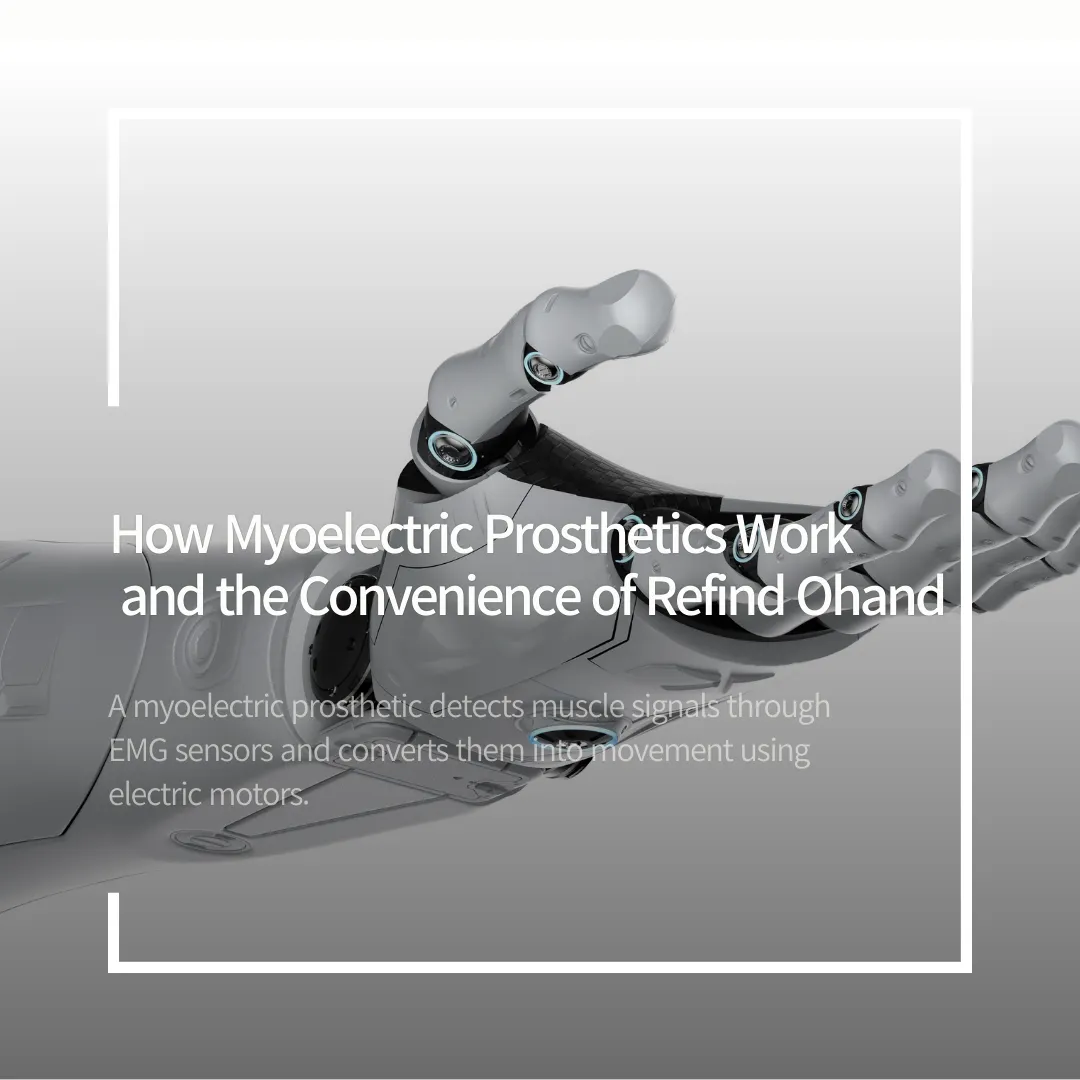
Myoelectric prosthetic hands have emerged as a new alternative that goes beyond traditional mechanical prostheses.
By combining muscle-signal detection with advanced sensor technology, they offer far greater convenience and allow users to move more freely in daily life.
Among them, Refind’s OHand and ROHAND stand out as a commercial prosthetic hand and a research-grade robotic hand, respectively.
How Myoelectric Prosthetics Work
A myoelectric prosthetic typically detects muscle signals using EMG (electromyography) sensors and converts them into movement through electric motors.
With only a slight contraction of the remaining muscles,
users can perform natural hand actions such as gripping or opening their fingers.
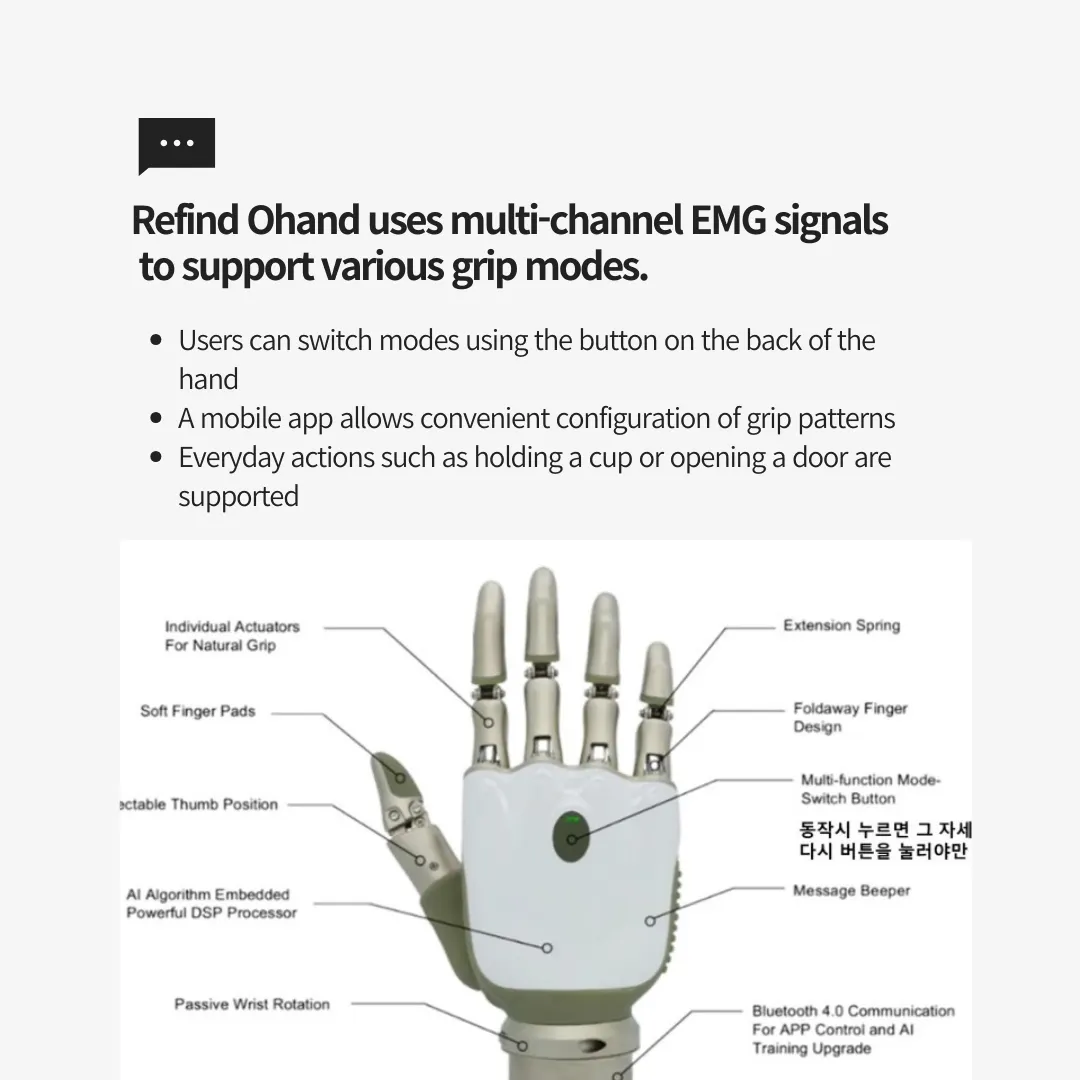
Refind’s OHand uses multi-channel EMG signals to support various grip modes.
Users can switch modes with a button on the back of the hand and even customize grip patterns through a mobile app.
This allows for much more than simple “open and close” motions—
it enables everyday activities such as holding a cup or opening a door in a natural and intuitive way.
The battery capacity supports a full day of use, and the device continues to improve based on user feedback.
Price of Myoelectric Prosthetics
The price of a myoelectric prosthetic varies depending on its technological level and degree of customization.
Refind’s OHand is considered relatively affordable within the global myoelectric prosthetics market.
Given its AI-based control system and mobile app integration, it is often evaluated as offering excellent performance for its price.
Differences Between Traditional and Myoelectric Prosthetics
•
Traditional prosthetic:
Mechanical structure with simple open–close motion; inexpensive but limited in function
•
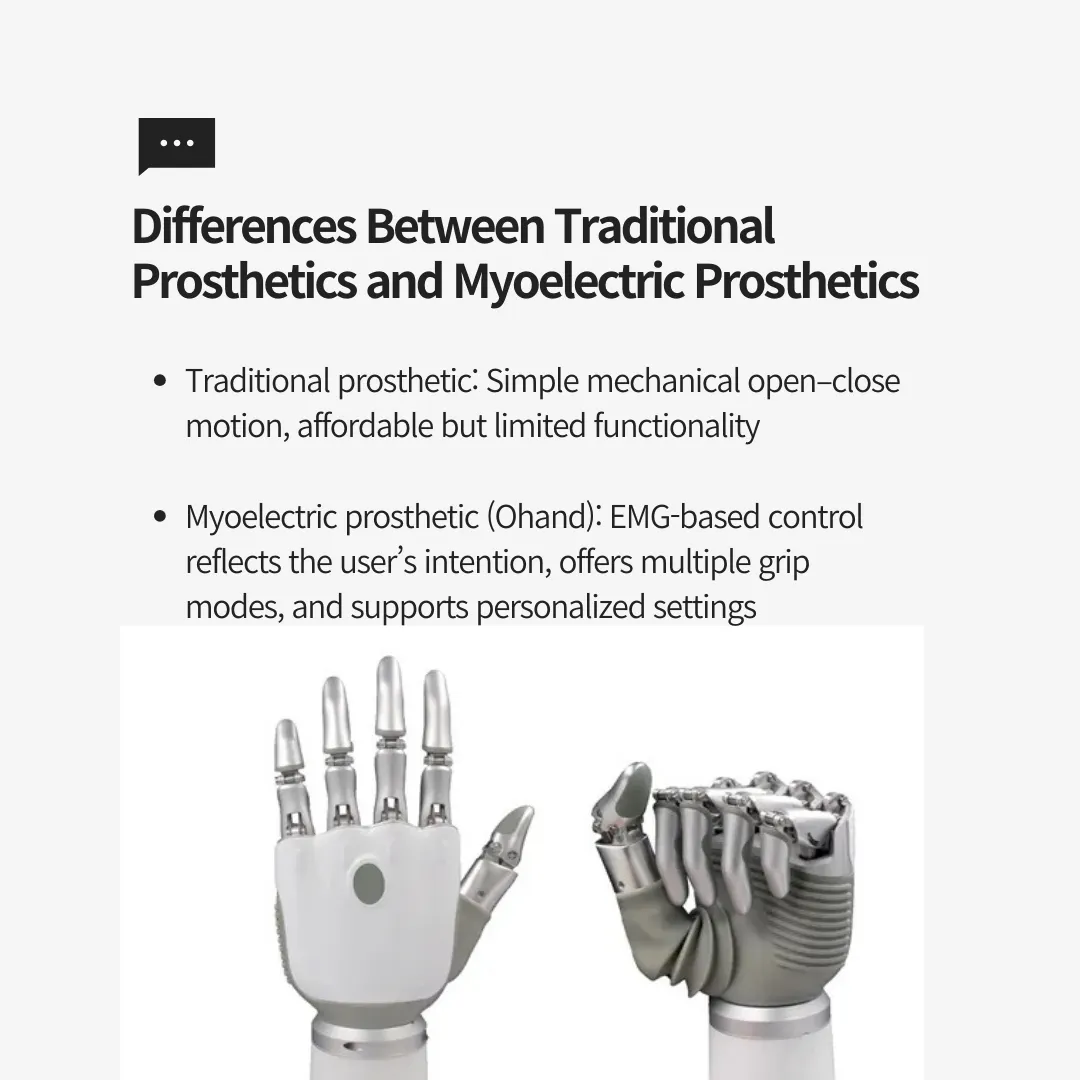
Myoelectric prosthetic (e.g., OHand):
EMG-based control that reflects the user’s intention; offers multiple grip modes and customizable settings
•
Research robotic hand (ROHAND):
Equipped with precision sensors and robotic interfaces; mainly used for research and industrial applications
These differences create a large gap in user experience.
Myoelectric prosthetics offer easier mode switching, more versatile movements, and reduced fatigue—leading to higher satisfaction during long-term use.
The Future of Myoelectric Prosthetics
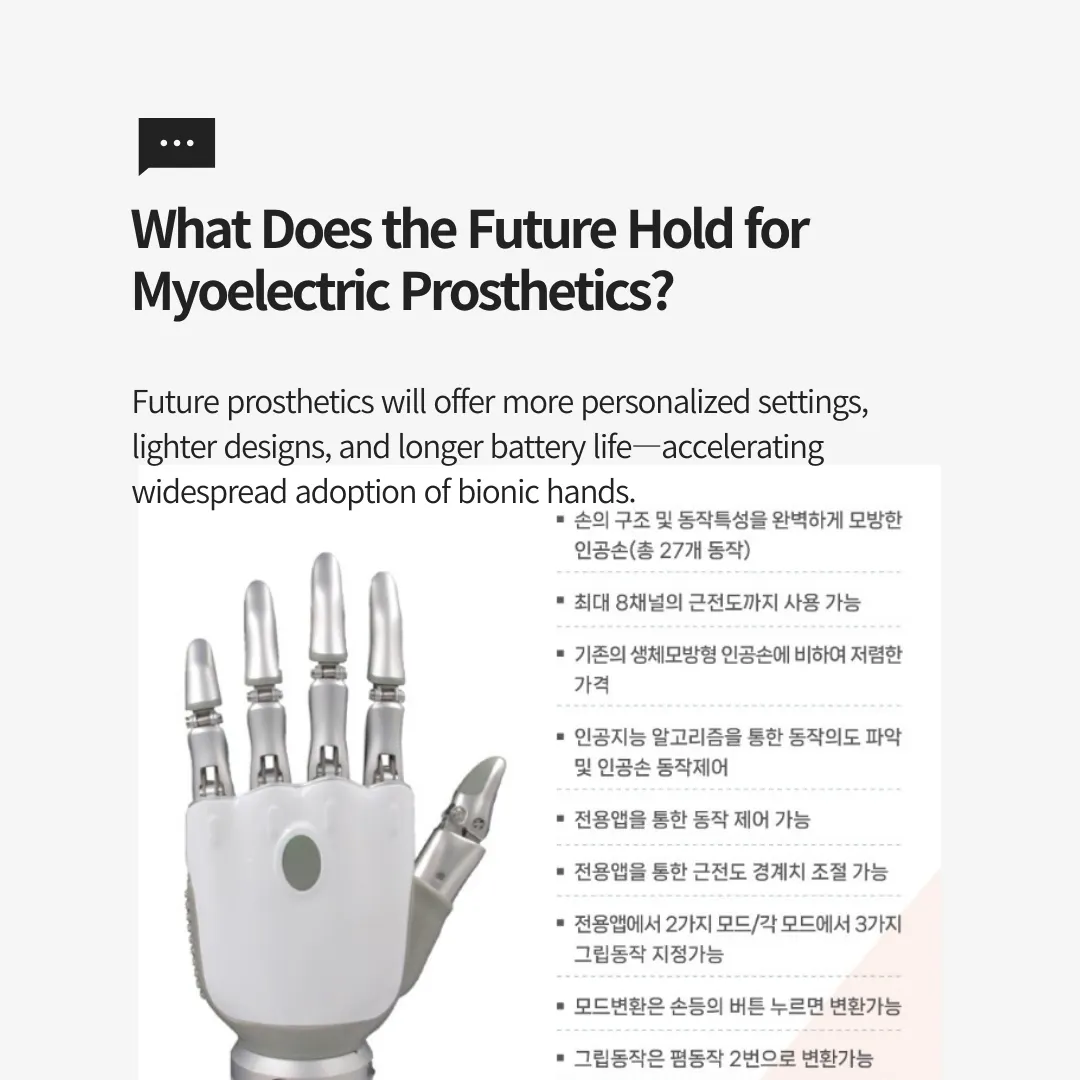
Myoelectric prosthetics are expected to become more sophisticated and widely accessible as AI, sensor technology, and battery performance continue to advance.
Features such as personalized settings, lighter designs, and long-duration battery life will further accelerate the adoption of myoelectric hands.